H. L. Turner Story--Part Two: Unique Perspectives about the History of Victor, Colorado and the Cripple Creek Mining District.
Submitted by Dick Turner (grandson).
Submitted by Dick Turner (grandson).
At age 10, Harry Louis (H.L.) Turner came to the Cripple Creek Mining District to live with his widowed father. Harry grew up in the rough mining camps and worked in many of the District’s most famous mines and mills while mastering several trades and raising a large family. Before continuing on to PART TWO, click the highlighted link to PART ONE featuring the fascinating story of H.L. Turner and his family if you have not previously viewed it.
PART TWO BEGINS HERE. As an early resident of the Cripple Creek District, H.L. Turner was extremely knowledgeable about the District’s history. He strongly identified with the miners, millwrights, blacksmiths and machinists of the District, and became a fierce critic of those he believed misrepresented or overly romanticized the early days of the District. He had little patience for the “yaps” and “ginks” and other fools who glorified oddball historical characters and events (usually for profit) while ignoring or downplaying the hard and dangerous work of the honest “working man".
In his later years H. L. Turner held strong opinions and unique perspectives about preserving a more accurate history of Victor and the Mining District, and looked for opportunities to share them. He relished reminiscing about his time in the District as he wrote dozens of unpublished letters to newspaper editors and authors to "correct" their mistakes.
Proud of his family and achievements, Harry remained a passionate learner, writer, and debater until his death in 1967 at the age of 85. Excerpted below is a sampling of Harry's views on topics he felt strongly about and expressed in a series of letters written between 1949 and 1965. *Italicized quotes are excerpted from a monograph Dick Turner compiled from selected unpublished letters written by his grandfather.
PART TWO BEGINS HERE. As an early resident of the Cripple Creek District, H.L. Turner was extremely knowledgeable about the District’s history. He strongly identified with the miners, millwrights, blacksmiths and machinists of the District, and became a fierce critic of those he believed misrepresented or overly romanticized the early days of the District. He had little patience for the “yaps” and “ginks” and other fools who glorified oddball historical characters and events (usually for profit) while ignoring or downplaying the hard and dangerous work of the honest “working man".
In his later years H. L. Turner held strong opinions and unique perspectives about preserving a more accurate history of Victor and the Mining District, and looked for opportunities to share them. He relished reminiscing about his time in the District as he wrote dozens of unpublished letters to newspaper editors and authors to "correct" their mistakes.
Proud of his family and achievements, Harry remained a passionate learner, writer, and debater until his death in 1967 at the age of 85. Excerpted below is a sampling of Harry's views on topics he felt strongly about and expressed in a series of letters written between 1949 and 1965. *Italicized quotes are excerpted from a monograph Dick Turner compiled from selected unpublished letters written by his grandfather.
Stagecoach Transportation to the Mining District in 1892
Mabel Barbee Lee's acclaimed book, Cripple Creek Days (published by Doubleday & Company in 1958) began with the story of how she first came to the Mining District from Florence, Colorado as a child in 1892 on a stagecoach that was held up by bandits. References to her book in the Florence Citizen spurred H.L Turner to send an unpublished letter to the editor on September 11, 1958 to correct factual discrepancies and provide a contrasting account (perhaps intended as a parody) of his stagecoach ride between Cripple Creek & Colorado Springs as a ten year old boy in 1892 accompanied by his Aunt Martha (Turner) Hood.
|
"I took a stagecoach trip in the early days between Cripple Creek and Colorado Springs with an aunt. I rode up front with the driver. Not that I was privileged, but no sensible adult wanted to ride in that swaying seat up there."
"My aunt was so distracted by the prospect of a supposedly dangerous trip that she did not catch on to what I was up to until it was too late." |
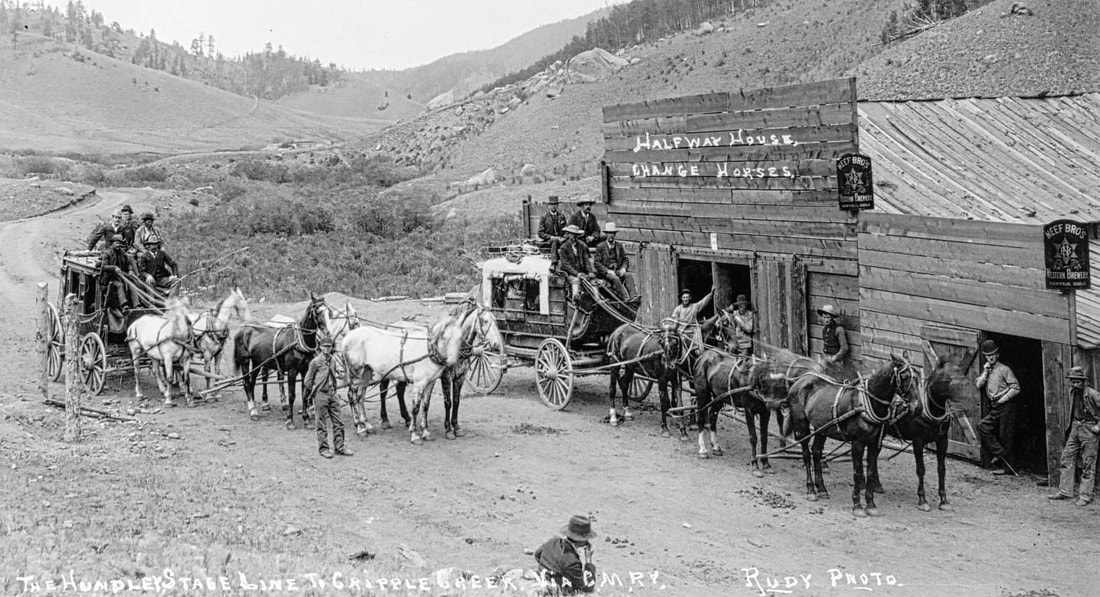
Halfway house for changing horses pulling the Hundley Stage Line to Cripple Creek. Rudy photo shared by Dick Turner. Click to enlarge.
|
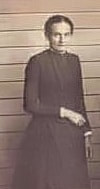 Aunt Martha (Turner) Hood at the Ruxton House in Manitou Springs. Photographer & date unknown. Photo from the H. L. Turner Collection.
"The driver had ... an intense and worried look throughout the trip. Not for fear of highwaymen or anything like that but because he had a schedule to meet. People, even though they are brought in by stage, have to meet trains you know. I believe post office people are equally snuffy whether the mail is late by stage or by train. How would YOU like the job of keeping to a schedule with a coach full of old women pulled by four or six notional horses over a mountain road? I want to remind you that women were always notorious back seat drivers. Even in stagecoach days."
"By the way, if a holdup HAD grabbed the mail sack off that stage he would have found no treasure. He would have found a bunch of letters from tenderfeet who had come West under the impression that after a little walking around they would stumble over a sizable pile of gold, or at least a large nugget. Well, it had not worked out that way and now they were writing home for money. Nothing so quickly reminds a wandering boy of the folks back home as an empty belly or a pair of worn out shoes."
"My aunt and I and the stage finally arrived at the halfway house where we changed horses and ate dinner. The dinner would have looked fine to a young boy anyway, but after my exciting ride with the driver mine tasted especially good. But my aunt got cantankerous and wouldn’t eat hers. Something she didn’t like about the appearance of the kitchen and then she found a fly in her coffee. Well she had a spoon did she not!? She could have fished the poor thing out."
"Then when we got ready to start one of the new horses got a cantankerous streak and before he was straightened out he had unharnessed himself and most of the rest of the team. That about decided my aunt to stay right where she was, but the memory of that poor fly kept her going and we went on to the Springs."
"By the way, if a holdup HAD grabbed the mail sack off that stage he would have found no treasure. He would have found a bunch of letters from tenderfeet who had come West under the impression that after a little walking around they would stumble over a sizable pile of gold, or at least a large nugget. Well, it had not worked out that way and now they were writing home for money. Nothing so quickly reminds a wandering boy of the folks back home as an empty belly or a pair of worn out shoes."
"My aunt and I and the stage finally arrived at the halfway house where we changed horses and ate dinner. The dinner would have looked fine to a young boy anyway, but after my exciting ride with the driver mine tasted especially good. But my aunt got cantankerous and wouldn’t eat hers. Something she didn’t like about the appearance of the kitchen and then she found a fly in her coffee. Well she had a spoon did she not!? She could have fished the poor thing out."
"Then when we got ready to start one of the new horses got a cantankerous streak and before he was straightened out he had unharnessed himself and most of the rest of the team. That about decided my aunt to stay right where she was, but the memory of that poor fly kept her going and we went on to the Springs."
Names of Lawrence & Victor
In 1956, Fred and Jo Mazzulla, authors of several books about Colorado history, published The First 100 Years: Cripple Creek and the Pikes Peak Region. H.L Turner provided his perspective on the book in an August 4, 1964 letter to the authors which included comments about how Lawrence and Victor were named.
|
Lawrence started out as a very good town. I went there with an aunt and uncle from Cripple Creek in late 1892 or possibly in early ’93. It was the earliest town in the District after Cripple Creek. It had the first successful mill in the district. Lawrence was laid out on the homestead of old man Lawrence. The town of Victor was not named after any Victor C. Adams. Victor was named after the Victor Mine.
|
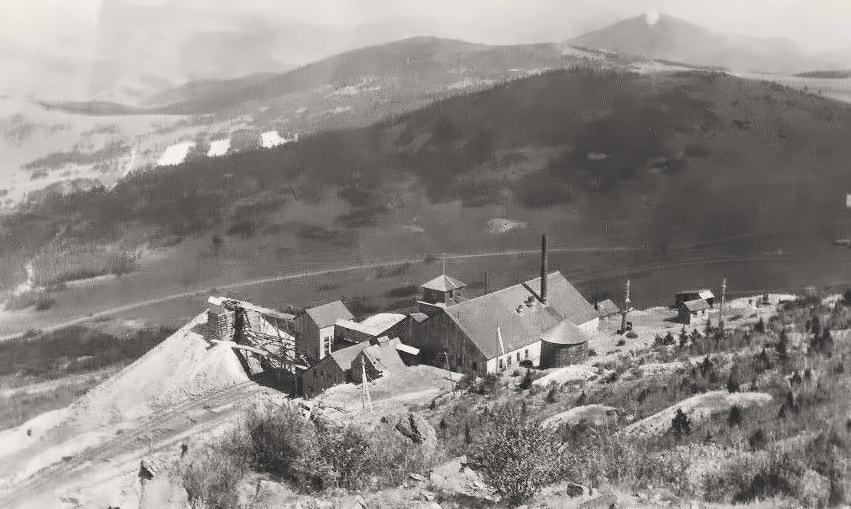
The Victor Mine near Bull Cliffs. H.L. Turner photo dated September 2, 1924. In an unpublished letter written in 1964, Turner asserted the name of the City of Victor came from the "Victor Mine" -- not from the name of Victor Adams, a local rancher.
|
Editor's Note: A similar explanation linking the name of the City of Victor to the name of the Victor Mine and the expectation of supremacy can be found in "A History of Victor, Colorado" published in 1933 by S. E. Poet, Superintendent of Public Schools in Victor. The theory that the City was named after an early pioneer, Victor Adams, is based on a story shared by the Adams family with the Victor ~ Lowell Thomas Museum. Both explanations acknowledge that the name of the City was selected by Mr. or Mrs. Harry Woods, perhaps for reasons known only to them and consequently now susceptible to more than one interpretation?
Alleged Prevalence of Highgrading by Miners
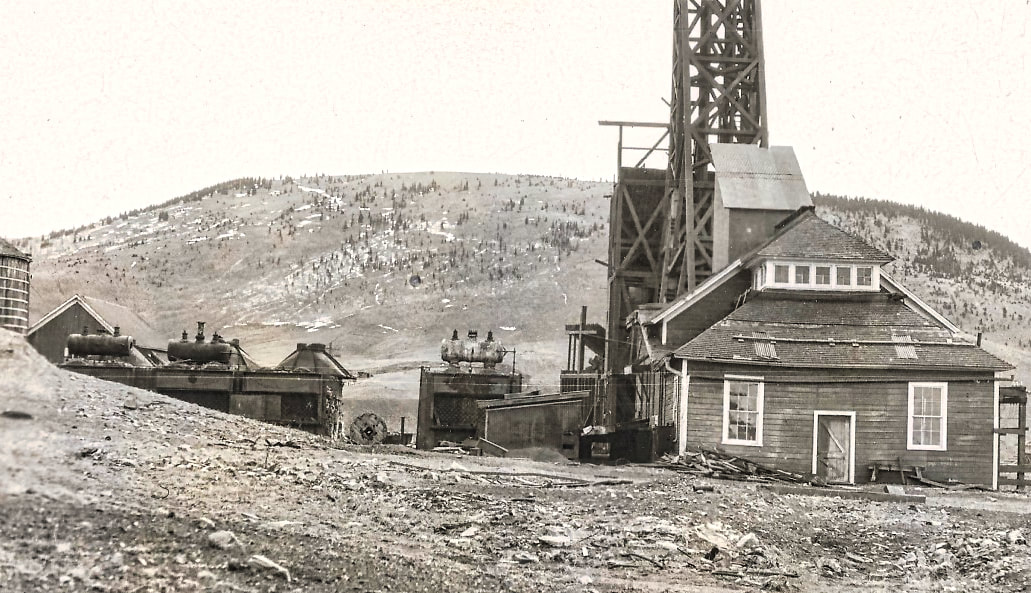 1930's H.L Turner Independence Mine photo where Harry once worked at every level from the 400 to the 1,400 -- and sometimes on the top crew. A 1906 photo from the H.L. Turner collection in Part 1 shows Harry in the Hoist Room of the Independence Mine.
In July of 1965 the Pueblo Chieftain published an article by Ralph C. Taylor that focused on the prevalence of “high-grading,” or ore theft, in Cripple Creek District mines including Stratton’s Independence. Harry was especially motivated to set the record straight due to his extensive experience working at the Independence and his sympathies for the miners Taylor portrayed as thieves. Excerpts from his letter to the Editor follow.
"You say that every miner devoted his time underground to thinking up ways to get away with stealing high-grade. ... Actually, mining is a type of work that has to be done by what might be called the task system: in sinking so many holes per round, so many holes per drift round, so many holes per stope round, and so on. And your holes had better break so much per round. Or else. And if you were a kid starting at the bottom, as I was when I worked on the Independence, you soon got acquainted with the use and capabilities of that oldest and most fundamental of all tools, the shovel. So many cars off the rough. So many cars off a plat. Or so many cars from a chute. Or else.
There was an immense surplus of labor ... about 4,000 men employed in the District at that time and about 3,500 men unemployed. The Independence at the time employed about 650 men. I remember one day when I was working as one of the top men, we counted about 675 men who came by and asked for jobs. So you hardly put in your time underground figuring how to steal some ore.
No one could carry enough high-grade ore in his false teeth or his hair or his shoes to amount to a damn. People were not allowed to carry pick handles in mine buckets or cages. Merchants were never offered high-grade in payment for goods. Any yahoo who offered high-grade in payment for anything would have found himself in jail in about 15 minutes. Harry was equally dismissive of the notion that ministers took their pay in high-grade.
According to Harry, Stratton never kept an armed guard on every level of the Independence Mine. He never kept an armed guard anywhere. The mine owners never organized any such thing as a High-Graders Association to fight high-graders. They organized a Mine Owners Association to fight the union. Change or dry rooms were put up at the mines so that a man could change from his working clothes to his street clothes. No one walked naked between the two rooms ... unless he wanted to.
"You say that every miner devoted his time underground to thinking up ways to get away with stealing high-grade. ... Actually, mining is a type of work that has to be done by what might be called the task system: in sinking so many holes per round, so many holes per drift round, so many holes per stope round, and so on. And your holes had better break so much per round. Or else. And if you were a kid starting at the bottom, as I was when I worked on the Independence, you soon got acquainted with the use and capabilities of that oldest and most fundamental of all tools, the shovel. So many cars off the rough. So many cars off a plat. Or so many cars from a chute. Or else.
There was an immense surplus of labor ... about 4,000 men employed in the District at that time and about 3,500 men unemployed. The Independence at the time employed about 650 men. I remember one day when I was working as one of the top men, we counted about 675 men who came by and asked for jobs. So you hardly put in your time underground figuring how to steal some ore.
No one could carry enough high-grade ore in his false teeth or his hair or his shoes to amount to a damn. People were not allowed to carry pick handles in mine buckets or cages. Merchants were never offered high-grade in payment for goods. Any yahoo who offered high-grade in payment for anything would have found himself in jail in about 15 minutes. Harry was equally dismissive of the notion that ministers took their pay in high-grade.
According to Harry, Stratton never kept an armed guard on every level of the Independence Mine. He never kept an armed guard anywhere. The mine owners never organized any such thing as a High-Graders Association to fight high-graders. They organized a Mine Owners Association to fight the union. Change or dry rooms were put up at the mines so that a man could change from his working clothes to his street clothes. No one walked naked between the two rooms ... unless he wanted to.
Heavy Duty Ore Hauling Wagons Pulled by Percheron Horses
In 1949 Harry began to correspond with Robert Falconer, editor of American Ironsmith Magazine, the official journal of the National Blacksmith’s Association. In one letter Harry described his experience learning the blacksmith trade as a young boy in the District. That led to the following discussion about the business of wagon making in the old time mining camp -- and the horses that pulled the wagons.
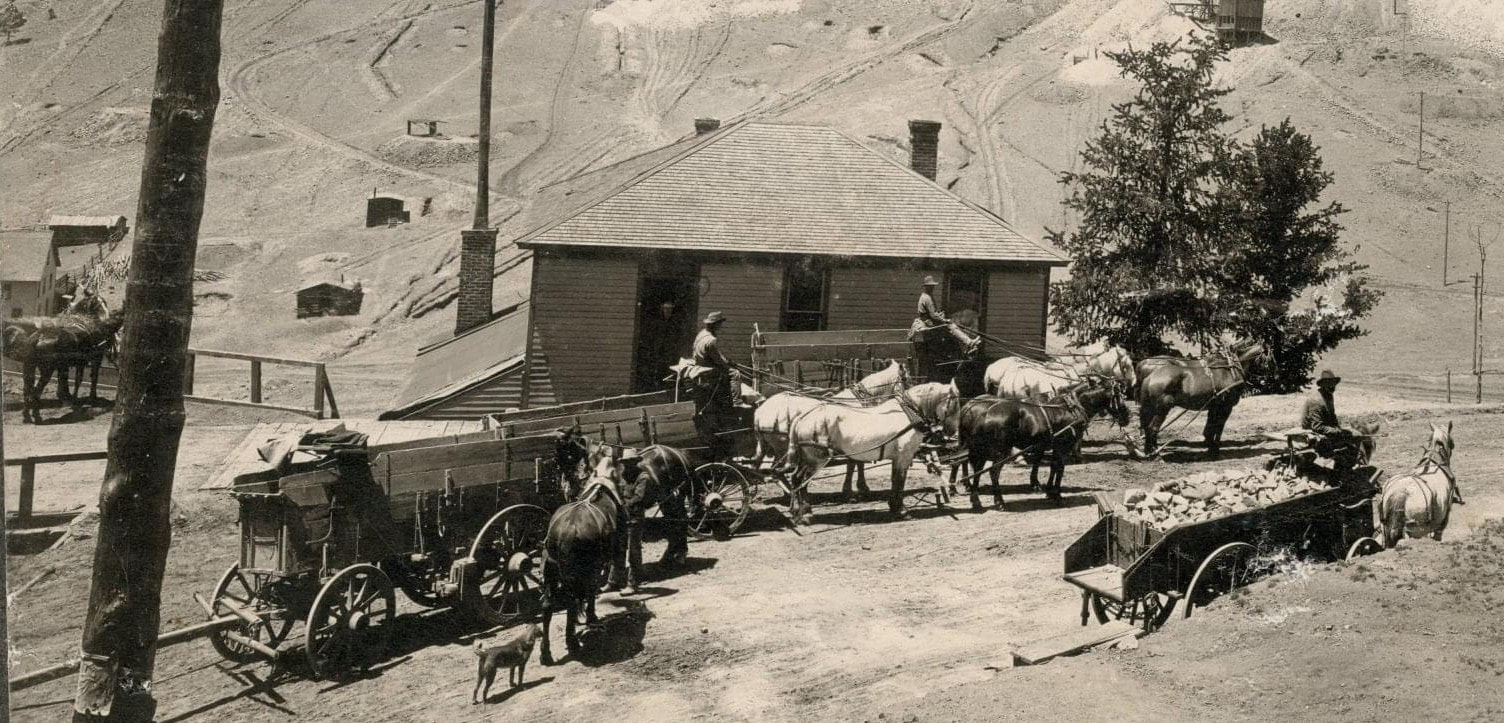
Ore Wagons at scale. 1901 photo from Cripple Creek District Museum. Photographer unknown.
An interesting feature of the old time mountain mining camp was the business of wagon making. None of the regular wagon builders made wagons that would do at all for hauling ore over the rough mountain roads so the big camps had their own wagon makers. An ore wagon would weigh from about 4,000 to over 5,000 pounds. The hubs, spokes, and fellows were so heavy that the wheel had the appearance of being almost solid. They used double tires for the downhill trips over the terribly rocky roads that would soon stretch a single tire. Both sets of tires would be 7/8” or 1” by 4”. A set of rough locks including chains weighed about 250 pounds, and believe me, you needed a good set of rough locks. These figures may look overdrawn to a regular wagon maker, but I am quite sure of them for I once had a job where part of the work was the weighing of the ore wagons, empty and loaded.
|
The most impressive thing about the ore hauling outfits .. was the horses pulling them. They were generally Percherons, called Normans in those days, and they might be close to a ton in weight. Nothing else has ever given me the impression of grandeur and power that the sight of six or eight of those great horses hitched to an ore wagon would give. They were a kind and gentle breed of horse and they led a hard and dangerous life for the roads were terrible. Not until the worthless, selfish human invented the automobile did the roads get fixed up.
|
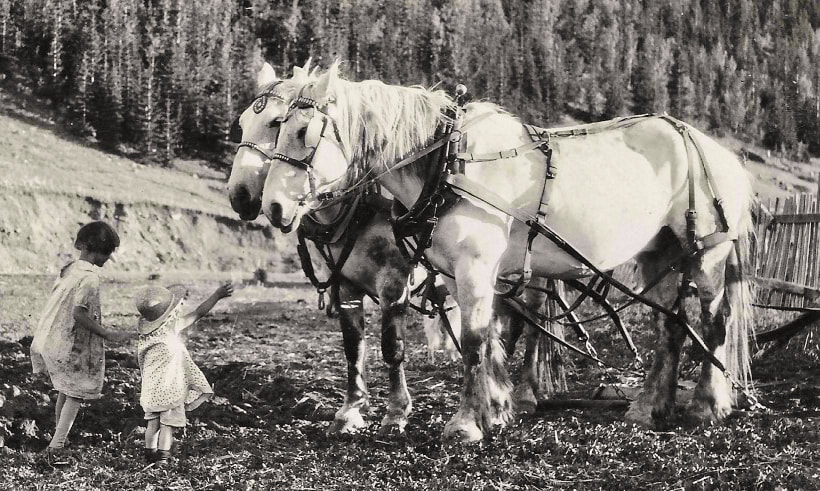
Alice & Lucy Turner with Bird & Buck, Percheron horses kept at the Turner home in Lawrence, Colorado, about 1931, H.L. Turner photo. Click to enlarge.
|
"H. L. Turner Story--Part Two: Unique Perspectives about the History of Victor, Colorado and the Cripple Creek Mining District" (submitted June 2022) by Dick Turner (grandson).
ABOUT THE AUTHORS, CONTRIBUTORS & SOURCES:
Dick Turner compiled a collection of his grandfather's unpublished letters in 2020 into a monograph titled "On Yaps and Ginks: Candid recollections of the early days in the Cripple Creek District from H.L. Turner." The italicized quotes included in his submission, "H.L. Turner Story--Part Two: Unique Perspectives about the History of Victor, Colorado and the Cripple Creek Mining District," are excerpted from Dick's monograph.
Biographical background about Harry Louis (H.L.) Turner, author of the unpublished letters excerpted above, can be accessed by clicking this link to PART ONE of the series titled "Memories of Harry Louis (H.L.) Turner (1882-1967) & His Experiences in the Early Days of the Cripple Creek Mining District". This first part of the H.L. Turner series was submitted by Dick Turner (grandson of H.L. Turner, son of Thomas Turner) and his cousin Ruth E. Stephan (granddaughter of H.L. Turner, daughter of James Turner) in May 2022. Dick lives in Sedona, Arizona; Ruth lives in Phoenix, Arizona and summers in Silver Cliff, Colorado.
Historic photos from the H.L. Turner Collection are featured in the 2022 Victor Heritage Calendar published by the Victor Heritage Society. To inquire if copies are still available, contact us via our email or snail-mail address shown below.
Dick Turner compiled a collection of his grandfather's unpublished letters in 2020 into a monograph titled "On Yaps and Ginks: Candid recollections of the early days in the Cripple Creek District from H.L. Turner." The italicized quotes included in his submission, "H.L. Turner Story--Part Two: Unique Perspectives about the History of Victor, Colorado and the Cripple Creek Mining District," are excerpted from Dick's monograph.
Biographical background about Harry Louis (H.L.) Turner, author of the unpublished letters excerpted above, can be accessed by clicking this link to PART ONE of the series titled "Memories of Harry Louis (H.L.) Turner (1882-1967) & His Experiences in the Early Days of the Cripple Creek Mining District". This first part of the H.L. Turner series was submitted by Dick Turner (grandson of H.L. Turner, son of Thomas Turner) and his cousin Ruth E. Stephan (granddaughter of H.L. Turner, daughter of James Turner) in May 2022. Dick lives in Sedona, Arizona; Ruth lives in Phoenix, Arizona and summers in Silver Cliff, Colorado.
Historic photos from the H.L. Turner Collection are featured in the 2022 Victor Heritage Calendar published by the Victor Heritage Society. To inquire if copies are still available, contact us via our email or snail-mail address shown below.
THE PAST MATTERS. PASS IT ALONG.
The Next Generation Will Only Inherit What We Choose to Save and Make Accessible.
Please Share Your Memories and Family Connections to Victor & the World's Greatest Gold Camp
By Contacting Victor Heritage Society, PO Box 424, Victor, CO 80860 or e-mail VictorHeritageSociety@gmail.com.
The Next Generation Will Only Inherit What We Choose to Save and Make Accessible.
Please Share Your Memories and Family Connections to Victor & the World's Greatest Gold Camp
By Contacting Victor Heritage Society, PO Box 424, Victor, CO 80860 or e-mail VictorHeritageSociety@gmail.com.
VictorHeritageSociety.com
Copyright © 2023 Victor Heritage Society. All Rights Reserved.
Copyright © 2023 Victor Heritage Society. All Rights Reserved.